Behind the façade: wells and passages
The embankments are the city’s formal face. Step through an arch and you are in its kitchen: yellow walls, drainpipes, a square of sky and somebody’s bicycle.
Wells
Land along the avenues was expensive, so nineteenth-century builders filled each plot to the edge and left only light shafts in the middle. The result is the courtyard Petersburgers call a well: four or five storeys of windows facing each other across a space the size of a tennis court, sometimes much smaller.
Stand in the centre and look straight up. The sky becomes a rectangle with a frame, clouds cross it like a slow film, and every sound — a spoon in a glass, a piano lesson, a radio — arrives from no particular direction.

Passages
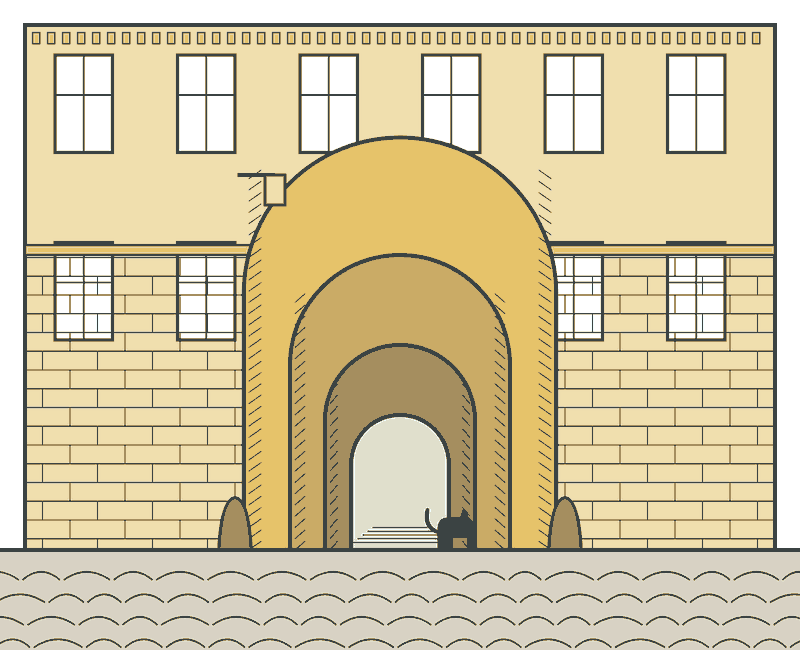
Many blocks were built as a chain of two, three or four courtyards joined by arches, so that carts could reach the back buildings. Where the gates are open these chains still work as short cuts, and locals of a certain age can cross half a district without touching a street. Fewer are open each year; residents fit locks, reasonably enough. Treat an open one as a favour, not a right.
What to look for
- Granite bollards at the foot of the arch, leaning outward. They kept carriage wheels from chewing the corners.
- Blank end walls with no windows at all. They are firewalls, built so that a blaze could not jump to the neighbour, and they give the city its odd windowless cliffs.
- The second staircase. Front stairs were for residents and guests; the plain back stair off the yard was for firewood, water and cooks.
- Trees. A single birch or lilac in a paved well is always somebody’s deliberate act, usually decades old.
- Cats, who have right of way.
Where to wander
Three districts reward aimless courtyard-hunting. On Vasilievsky Island the side streets are called Lines and numbered, a leftover from a scheme to dig canals that was never carried through, and the yards between them are deep and green. The Petrograd Side has the grandest arches, built in the 1900s with glazed tiles and wrought iron. Kolomna has the oldest and plainest, and the most cats. The Kolomna loop and the Petrograd Side walk both leave time for it.
Manners
People live here. Keep your voice down, because a well amplifies everything. Do not photograph into windows, do not try a gate that is shut, and if someone asks what you are doing, “admiring your courtyard” said with a smile has never yet failed me. Leave when you have looked.